Selling the photo shoot away — AI product imagery for cosmetics listings
Open the real page ↗kmong.com · alive as of 2026-08-16
A listing that builds product detail pages for cosmetics sellers. This is the clearest case of what AI actually removed: the studio shoot and the model booking. No revenue figure is published, so we print none — only the platform-displayed transaction count and the published prices.
In plain words
She makes product pages for people selling cosmetics online. Normally that means renting a studio and booking a model. Instead she puts one phone photo into AI and gets magazine-style shots out. The whole cost of the photo shoot disappears. Prices run ₩150,000 to ₩1,350,000.
The whole thing at a glance
To whom
Cosmetics and beauty sellers…
What
Content service
Found how
Kmong — marketplace search p…
Paid how
Three fixed packages
Flow: To whom, then What, then Found how, then Paid how
The money path, in real screenshots
Screenshots we took ourselves. Each carries the date and the address it came from — don't take our word for it, open the page.
Step 1. What it costs kmong.comOpen the real page ↗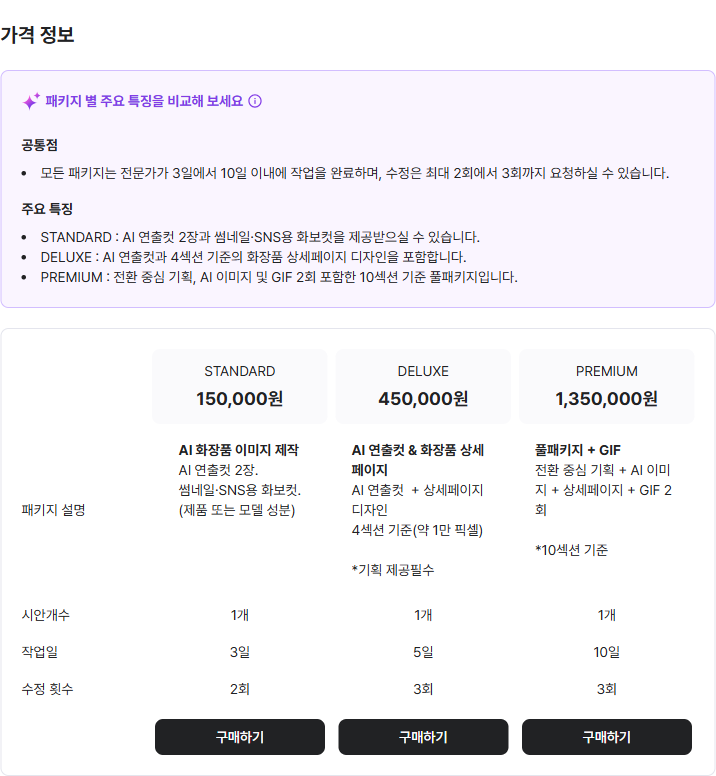
↔ Swipe sideways on a narrow screen
Same three tiers, a much steeper top. ₩150,000 / ₩450,000 / ₩1,350,000. The bottom tier is “two AI images.” The top is “conversion-led planning plus ten sections.” What raised the price is the planning, not the AI — the moment the deliverable shifts from “make it” to “make it sell,” the number goes up ninefold.
Captured 2026-08-16 · it may have changed since
Step 2. Did anyone buy kmong.comOpen the real page ↗
↔ Swipe sideways on a narrow screen
23 orders, 99% satisfaction. And here is where it diverges from the previous case — this is a business account, so tax invoices are available. Business customers ask for them. If that box says “not available,” those orders never arrive in the first place. Registering as a business is a precondition, not a later step.
Captured 2026-08-16 · it may have changed since
These screenshots are quoted for analysis; the underlying pages belong to their owners. We left out faces and the sellers' education and career panels — what we are reading is the price and the order record, not the person.
- Founder
- Youngji Yoon (Studio Bob)
- Country
- KR
- Team
- —
- Startup cost
- —
- To first revenue
- —
- Automation
- mid
- Reported revenue
- Revenue not disclosed
What is sold
Three fixed packages (images only / images plus page / full package)
STANDARD ₩150,000 (2 AI scene shots) / DELUXE ₩450,000 (4-section page) / PREMIUM ₩1,350,000 (10-section full package with GIFs). Checked 2026-08-15.
Who buys
Cosmetics and beauty sellers on Korean marketplaces, and small brands
What arrives is not what you keep
- What the customer paidThe number on the invoice
- AI toolsA share of the monthly subscription
- Platform feeDiffers by platform
- TaxDiffers by country and business form
- What is leftAt or below zero, it is not a price
This case does not publish its own tool costs, fees or tax. So we show the order and the items only — put your own numbers into the calculator.
AI's part and the person's part
Already had
Eight-plus years in design — agency art director, startup design lead — per the profile. Twelve portfolio pieces are published with client names.
If this is large, the AI is not the reason
What the AI did
Takes a single product photo as input and generates AI scene and model shots from it, replacing the studio shoot and model booking. The input being one phone photo is the point — the buyer has almost nothing to prepare.
the part a tool replaced
What the person did
Reading the brand concept, planning the page, retouching and compositing the AI output, and laying out sections. The listing itself says an art director retouches the output rather than shipping raw generations.
stories that omit this do not replicate
How customers were found
Kmong — marketplace search placement
Twelve public portfolio pieces, client names attached
Platform-displayed “replies within 1 hour”
Paying customers
STANDARD ₩150
Flow: Kmong — marketplace search placement, then Twelve public portfolio pieces, client names attached, then Platform-displayed “replies within 1 hour”, then Paying customers
How we verified this
Public dashboard or platform figure. May be self-reported
Checked the Kmong listing directly on 2026-08-15. Platform-displayed values — 23 completed transactions, 99% satisfaction, 13 reviews averaging 4.9, corporate account. The seller's real name is public on the profile. No revenue figure is published, so we print none. ⚠️ One review ends by recommending a *different* marketplace, which suggests it was pasted from elsewhere — a good illustration of why we do not treat review text as evidence. The listing does not name the AI tools used, so that field is left empty.
- Kmong listing — transactions, satisfaction, reviews, prices, portfolio (marketplace · checked 2026-08-15)
What made it work
What AI replaced is not craft but a fixed cost. Once the studio, model and lighting drop out, the buyer stops comparing this against other designers and starts comparing it against a shoot quote. Changing the comparison is what makes the price work. The art direction is still done by a person.
Risks
- Existing design skill carries much of this. Generating an image is easy; getting to “a brand can ship this today” is what eight years of experience buys.
- A four-star review notes the product packaging was hard to render — results vary by product shape.
- The low barrier cuts both ways: similar listings multiply quickly and compete on price.
Does this work in Korea?
The buyers are domestic sellers, so it applies directly. Note that cosmetics pages fall under Korean cosmetics advertising rules — efficacy wording in the imagery is ultimately the brand's liability. Whether AI-generated imagery must be labelled depends on the platform and the brand, so it is safer to settle that before the contract.
Solo-feasible: partially · Automation: mid
7-day action plan
Step 1. Shoot one product on your phone, generate scene shots from it, and count the attempts until one is usable
Step 2. Multiply that count by your tool costs to get a per-image cost
Step 3. Write down the prices of ten comparable listings and compare against your cost
30-day action plan
Step 1. Narrow to one product type and build three portfolio pieces yourself
with no client
Step 2. List the service with those three and sell only the smallest package first
Step 3. Count the revision rounds on the first order, and put that number into the next price list
Run the numbers
We do not print a single projected figure here. Put your own numbers in instead.
How this reads for you
Answer 13 questions and we work out what this case would take in your situation. Answers stay in this browser.
Find models that fit youGet the next verification result
We check the AI income stories people are talking about, grade the evidence, and send you what we found — including what we could not confirm.
Income models this case supports
- Level 1AI product imagery service
Related cases
Words you may not know
- Verification grade
- How far we checked this case. A means the revenue was confirmed by someone other than the founder; B means the business exists but the revenue is only the founder's word.
- Revenue
- Everything that came in. Tools, fees and tax still have to come out before it is what you keep. The two are not the same.
- MRR
- Money that arrives every month, as opposed to a one-time payment.
- Self-reported
- A number the person stated about themselves. Nobody else confirmed it, which is why we do not print those numbers.
- Replicability
- How likely someone else is to get a similar result. The more the founder already knew the field, the harder it is to copy.