Selling AI chatbot builds on a Korean freelance marketplace, alongside a full-time job
Open the real page ↗kmong.com · alive as of 2026-08-16
A one-person listing that sells internal-document chatbots as fixed packages on Kmong, Korea's largest freelance marketplace. No revenue figure is published anywhere, so we do not print one. What we do print is the platform-displayed transaction count and the published price list — the price band is the useful part here.
In plain words
He builds a chatbot that searches a company's own documents. An employee asks “what was last year's leave policy?” and the bot digs through the files and answers. The price is fixed up front — ₩150,000 to ₩700,000 — and it takes three to seven days. He sells this alongside a full-time job.
The whole thing at a glance
To whom
Companies automating interna…
What
Automation agency
Found how
Kmong — marketplace search p…
Paid how
Three fixed packages
Flow: To whom, then What, then Found how, then Paid how
The money path, in real screenshots
Screenshots we took ourselves. Each carries the date and the address it came from — don't take our word for it, open the page.
Step 1. What it costs kmong.comOpen the real page ↗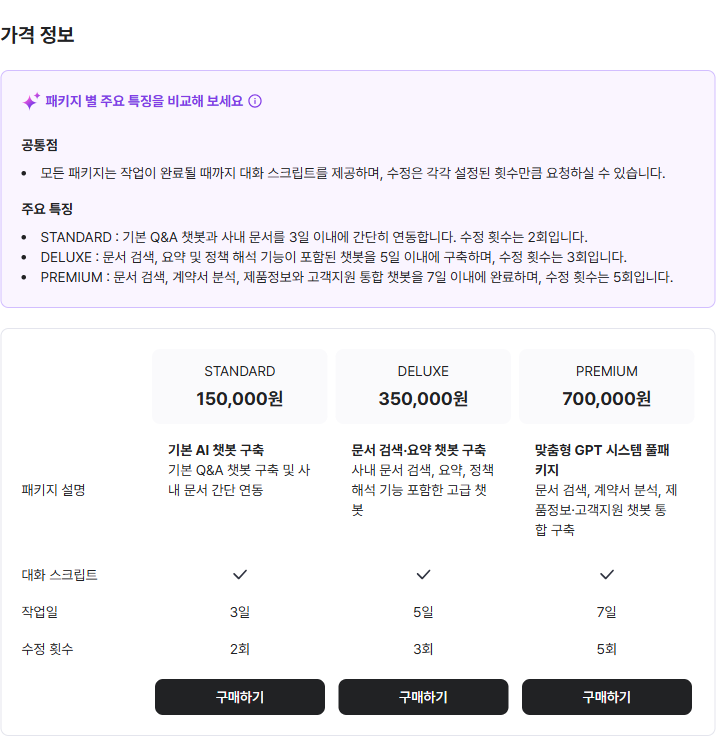
↔ Swipe sideways on a narrow screen
The price ladder. Three tiers: ₩150,000 / ₩350,000 / ₩700,000. The tiers do not just cost more — delivery days (3/5/7) and revisions (2/3/5) go up with them. The expensive tier is not better AI. It is more of your hours.
Captured 2026-08-16 · it may have changed since
Step 2. Did anyone buy kmong.comOpen the real page ↗
↔ Swipe sideways on a narrow screen
Did anyone actually buy? These numbers come from Kmong, not the seller — 18 completed orders, 96% satisfaction. Better than a screenshot the seller posted themselves. Even so, no revenue figure exists anywhere. Multiplying 18 orders by a listed price would be an estimate, so we do not do it. Note the two boxes on the right: this is an individual account, so it cannot issue tax invoices.
Captured 2026-08-16 · it may have changed since
These screenshots are quoted for analysis; the underlying pages belong to their owners. We left out faces and the sellers' education and career panels — what we are reading is the price and the order record, not the person.
- Founder
- Nunnopi Coding (Kmong seller name)
- Country
- KR
- Team
- 1
- Startup cost
- —
- To first revenue
- —
- Automation
- mid
- Reported revenue
- Revenue not disclosed
What is sold
Three fixed packages, separated by scope, turnaround and revision count
STANDARD ₩150,000 (3 days, 2 revisions) / DELUXE ₩350,000 (5 days, 3) / PREMIUM ₩700,000 (7 days, 5). Checked 2026-08-15.
Who buys
Companies automating internal document search and customer replies
What arrives is not what you keep
- What the customer paidThe number on the invoice
- AI toolsA share of the monthly subscription
- Platform feeDiffers by platform
- TaxDiffers by country and business form
- What is leftAt or below zero, it is not a price
This case does not publish its own tool costs, fees or tax. So we show the order and the items only — put your own numbers into the calculator.
AI's part and the person's part
Already had
MSc in computer science. Machine-learning engineer, then data scientist, then analytics consultant, and VP of Engineering since February 2025 according to the profile. This is a side listing run alongside a full-time role.
If this is large, the AI is not the reason
What the AI did
Builds chatbots that search and summarise a company's own documents and interpret internal policy. The platform lists the tools used as ChatGPT, Midjourney, DALL·E and Stable Diffusion. What is sold is not AI itself but the configuration against one company's documents.
the part a tool replaced
What the person did
Requirement interviews, workflow design, document indexing and embedding settings, delivery and a usage guide. The listing says structure matters more than document volume — setting up that structure is the human part.
stories that omit this do not replicate
Tools: ChatGPT · Midjourney · DALL·E · Stable Diffusion
How customers were found
Kmong — marketplace search placement
Platform-displayed “replies within 3 hours” (a ranking signal)
Paying customers
STANDARD ₩150
Flow: Kmong — marketplace search placement, then Platform-displayed “replies within 3 hours” (a ranking signal), then Paying customers
How we verified this
Public dashboard or platform figure. May be self-reported
Checked the Kmong listing directly on 2026-08-15. Platform-displayed values — 18 completed transactions, 96% satisfaction, individual (not corporate) account, team size 1. The price list is published on the page and copied as-is. ⚠️ Those 18 transactions are the seller's total across all listings; this chatbot listing itself is new and has zero reviews. No revenue figure is published anywhere, so we print none — multiplying transactions by price would be our estimate, not a fact.
- Kmong listing — transactions, satisfaction, team size and prices (marketplace · checked 2026-08-15)
What made it work
What is sold is the setup, not the AI. Buyers are not stuck because they cannot use ChatGPT; they buy so they do not have to fit it to their own documents. That is also why the price list is split by scope, turnaround and revision count rather than by outcome — the product is a bounded amount of labour.
Risks
- The expertise bar is high. A master's degree and a work history are doing the trust work here; the same prices are hard to charge without them.
- We cannot confirm this listing sells at all — it has zero reviews, and the 18 transactions belong to other listings. How long a new listing takes to get its first order is not something this case answers.
Does this work in Korea?
This is a domestic case, so there is little friction. Kmong accepts individual accounts and handles payment and settlement. Platform fees and income reporting are the seller's own; whether they can issue a tax invoice matters to corporate buyers — this seller is marked as unable to.
Solo-feasible: yes · Automation: mid
7-day action plan
Step 1. Search a freelance marketplace for “AI chatbot build” and copy the price lists of the top ten
Step 2. Tabulate what those ten have in common: document integration, revision count, turnaround
Step 3. Pick the smallest scope you could deliver within three days
30-day action plan
Step 1. List that scope once, priced near the low end of those ten
Step 2. Log how long you take to answer each enquiry
platforms rank on it
Step 3. After the first order, measure the hours you actually spent and divide. If the hourly rate is poor, cut the scope
Run the numbers
We do not print a single projected figure here. Put your own numbers in instead.
How this reads for you
Answer 13 questions and we work out what this case would take in your situation. Answers stay in this browser.
Find models that fit youGet the next verification result
We check the AI income stories people are talking about, grade the evidence, and send you what we found — including what we could not confirm.
Income models this case supports
- Level 2AI chatbot and GPT builds
Related cases
Words you may not know
- Verification grade
- How far we checked this case. A means the revenue was confirmed by someone other than the founder; B means the business exists but the revenue is only the founder's word.
- Revenue
- Everything that came in. Tools, fees and tax still have to come out before it is what you keep. The two are not the same.
- MRR
- Money that arrives every month, as opposed to a one-time payment.
- Self-reported
- A number the person stated about themselves. Nobody else confirmed it, which is why we do not print those numbers.
- Replicability
- How likely someone else is to get a similar result. The more the founder already knew the field, the harder it is to copy.