“Four jobs a month” — the ceiling an automation seller set on themselves
Open the real page ↗kmong.com · alive as of 2026-08-16
A Korean listing that automates repetitive store, social and YouTube work. Three published tiers (₩290,000 / ₩890,000 / ₩1,900,000), published delivery times (3 / 14 / 20 days), and platform-displayed stats: 78 completed orders, 100% satisfaction. No revenue figure is published, so we print none. What makes this one worth reading is a line in the seller's profile: they take only four jobs a month, and they say so themselves.
In plain words
Shops and YouTubers repeat the same chores every day. This seller makes those chores run by themselves. Three prices — ₩290,000 to ₩1,900,000 — taking 3, 14 and 20 days. The interesting part: the seller writes that they accept only four jobs a month. Even someone who sells automation has a limited number of months' worth of work in them.
The whole thing at a glance
To whom
Online store operators and s…
What
Automation agency
Found how
Kmong search placement
Paid how
Three-tier fixed-scope servi…
Flow: To whom, then What, then Found how, then Paid how
The money path, in real screenshots
Screenshots we took ourselves. Each carries the date and the address it came from — don't take our word for it, open the page.
Step 1. What it costs kmong.comOpen the real page ↗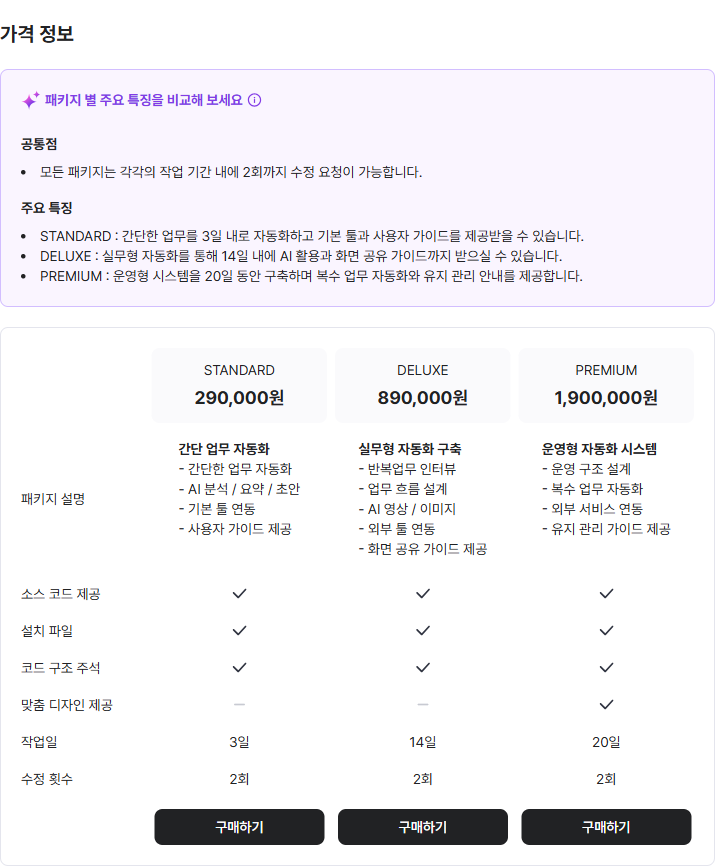
↔ Swipe sideways on a narrow screen
Watch the middle tier. ₩890,000 is 3× the base price, but delivery goes from 3 days to 14 — nearly 5×. Over a month, the cheap tier leaves more behind than the middle one. Raising your price and earning more are different things; the arithmetic is on the income-model page.
Captured 2026-08-16 · it may have changed since
Step 2. Did anyone buy kmong.comOpen the real page ↗
↔ Swipe sideways on a narrow screen
78 orders, 100% satisfaction. The tax-invoice box differs again from the earlier listings — here Kmong issues them directly. Three variants exist (available / not available / issued by Kmong), and which one you show decides what kind of orders you can take. We do not multiply orders by price here either.
Captured 2026-08-16 · it may have changed since
These screenshots are quoted for analysis; the underlying pages belong to their owners. We left out faces and the sellers' education and career panels — what we are reading is the price and the order record, not the person.
- Founder
- Takepage (Kmong seller handle)
- Country
- KR
- Team
- —
- Startup cost
- —
- To first revenue
- —
- Automation
- mid
- Reported revenue
- Revenue not disclosed
What is sold
Three-tier fixed-scope service, sold through a marketplace
STANDARD ₩290,000 (3 days) · DELUXE ₩890,000 (14 days) · PREMIUM ₩1,900,000 (20 days), two revisions on every tier. Copied off the listing on 2026-08-16. ⚠️ There is a trap in this table: the middle tier is the worst one. It costs three times the base tier but takes nearly five times as long, so over a month it leaves less behind.
Who buys
Online store operators and small businesses running their own social channels
What arrives is not what you keep
- What the customer paidThe number on the invoice
- AI toolsA share of the monthly subscription
- Platform feeDiffers by platform
- TaxDiffers by country and business form
- What is leftAt or below zero, it is not a price
This case does not publish its own tool costs, fees or tax. So we show the order and the items only — put your own numbers into the calculator.
AI's part and the person's part
Already had
No education or work history is shown on the profile. Undisclosed stays undisclosed — unlike the earlier Korean listings, we cannot tell whether credentials are holding this price up.
If this is large, the AI is not the reason
What the AI did
The price table names what the AI does: “AI analysis / summary / draft” in the base tier and “AI video / image” in the middle one. The AI produces the output; what is sold is the plumbing that makes the output appear on its own.
the part a tool replaced
What the person did
Interviewing the client about their repetitive work, designing the flow, wiring external tools, and walking them through it are all human. What grows tier by tier is design and hand-holding, not AI.
stories that omit this do not replicate
How customers were found
Kmong search placement (top of results for “AI automation” in Korean)
Platform-displayed order count and satisfaction (17 reviews)
Paying customers
STANDARD ₩290
Flow: Kmong search placement (top of results for “AI automation” in Korean), then Platform-displayed order count and satisfaction (17 reviews), then Paying customers
How we verified this
Public dashboard or platform figure. May be self-reported
We opened the Kmong listing ourselves on 2026-08-16 and captured the screens. Platform-displayed values — 78 completed orders, 100% satisfaction, business account, tax invoices issued by Kmong directly, 17 reviews. Prices and delivery times are published on the page and copied as-is. No revenue figure is published anywhere, so we print none. Multiplying 78 orders by a price would be our estimate, not a fact — the page does not say which tier those orders were, or over what period they accumulated. ⚠️ It is a business account, so we cannot confirm this is one person. With no credentials shown, we have less to judge replicability on than in the earlier listings.
- Kmong listing — three-tier pricing, delivery days, order count, satisfaction (marketplace · checked 2026-08-16)
What made it work
Selling automation does not free you from your own calendar. This seller writes on their profile that they take only four jobs a month. It is their own statement, but it lands in the same range as our arithmetic on their published delivery times (six at the base tier, one each at the middle and top). You can remove someone else's repetitive work with AI and still have only twenty working days yourself. Getting past that means hiring, or moving to selling something already built.
Risks
- The middle-tier trap. ₩890,000 is three times the base price, but delivery goes from 3 days to 14. Over a month it leaves less than the cheap tier does — raising your price and earning more are different things.
- One-person status is unconfirmed: business account, no team size shown.
- No credentials are shown, so we cannot tell what holds this price up.
- The low end (₩290,000) is easy to enter, and easy entry compresses prices.
Does this work in Korea?
A domestic case, so nothing blocks it locally. Note that tax invoices here are marked “issued by Kmong directly” — a third variant next to the earlier listings' “available” and “not available.” Which one a listing shows decides what kind of business orders it can accept at all.
Solo-feasible: partially · Automation: mid
7-day action plan
Step 1. Search “AI automation” on a Korean marketplace and copy the price table and delivery time of the top ten listings
Step 2. Divide price by delivery days for each
the expensive tier is not automatically the better one
Step 3. Pick one automation you could finish inside three days
30-day action plan
Step 1. Run that automation on your own work first, and write down the time it took and where it broke
Step 2. Do it once more in someone else's environment
their accounts and their tools are where the real cost hides
Step 3. Fix a delivery time, then scope the offer to what actually fits inside it
Run the numbers
We do not print a single projected figure here. Put your own numbers in instead.
How this reads for you
Answer 13 questions and we work out what this case would take in your situation. Answers stay in this browser.
Find models that fit youGet the next verification result
We check the AI income stories people are talking about, grade the evidence, and send you what we found — including what we could not confirm.
Income models this case supports
- Level 3AI automation agency
Related cases
Words you may not know
- Verification grade
- How far we checked this case. A means the revenue was confirmed by someone other than the founder; B means the business exists but the revenue is only the founder's word.
- Revenue
- Everything that came in. Tools, fees and tax still have to come out before it is what you keep. The two are not the same.
- MRR
- Money that arrives every month, as opposed to a one-time payment.
- Self-reported
- A number the person stated about themselves. Nobody else confirmed it, which is why we do not print those numbers.
- Replicability
- How likely someone else is to get a similar result. The more the founder already knew the field, the harder it is to copy.