An AI quiz generator built alongside a day job — QuestGen
Open the real page ↗questgen.ai · alive as of 2026-08-16
A data scientist built an AI quiz and question generator while keeping a day job. We do not publish a revenue figure: the only source is the founder. What we do publish is what was sold, to whom, and why this case is hard for a non-specialist to repeat.
In plain words
He sells a program that writes quiz questions for you. Making questions by hand takes teachers a long time; this program takes a document or a video and writes the questions instead. He already worked with data for a living, which is why he could build it. The amount he earns is only his own statement, so we do not print it.
The whole thing at a glance
To whom
Teachers and schools
What
AI SaaS
Found how
Product-led — free trial
Paid how
SaaS subscription
Flow: To whom, then What, then Found how, then Paid how
The money path, in real screenshots
Screenshots we took ourselves. Each carries the date and the address it came from — don't take our word for it, open the page.
Step 1. What is sold questgen.aiOpen the real page ↗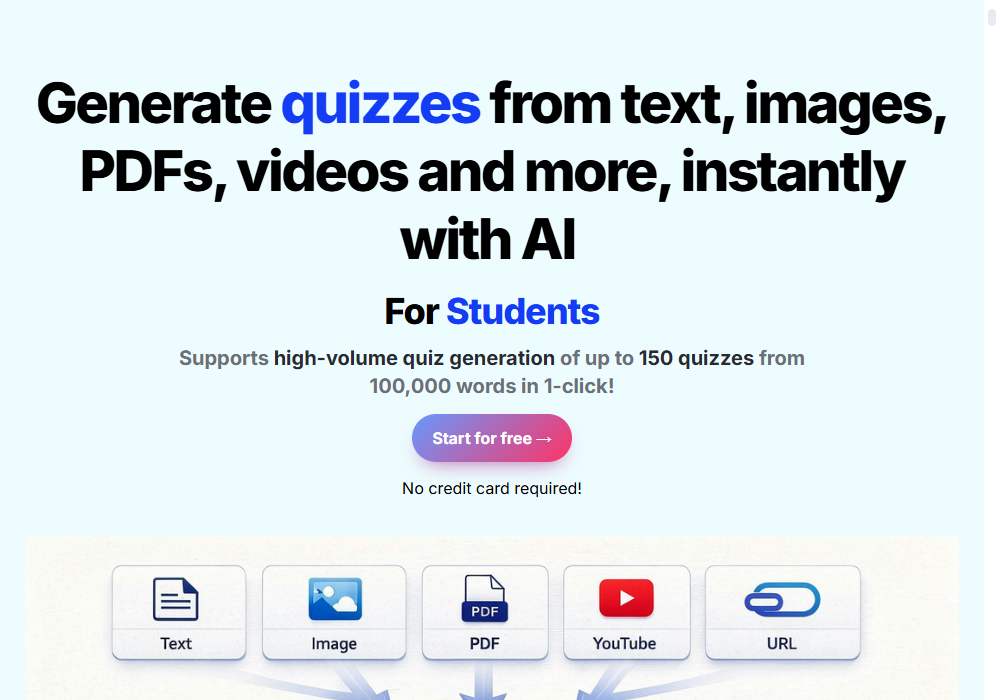
↔ Swipe sideways on a narrow screen
What is sold. Put in text, images, PDFs or video and it writes the questions for you. The button reads “Start for free,” with “No credit card required” below it — you use the thing before any money changes hands. The word after “For …” rotates between visits.
Captured 2026-08-16 · it may have changed since
Step 2. What it costs questgen.aiOpen the real page ↗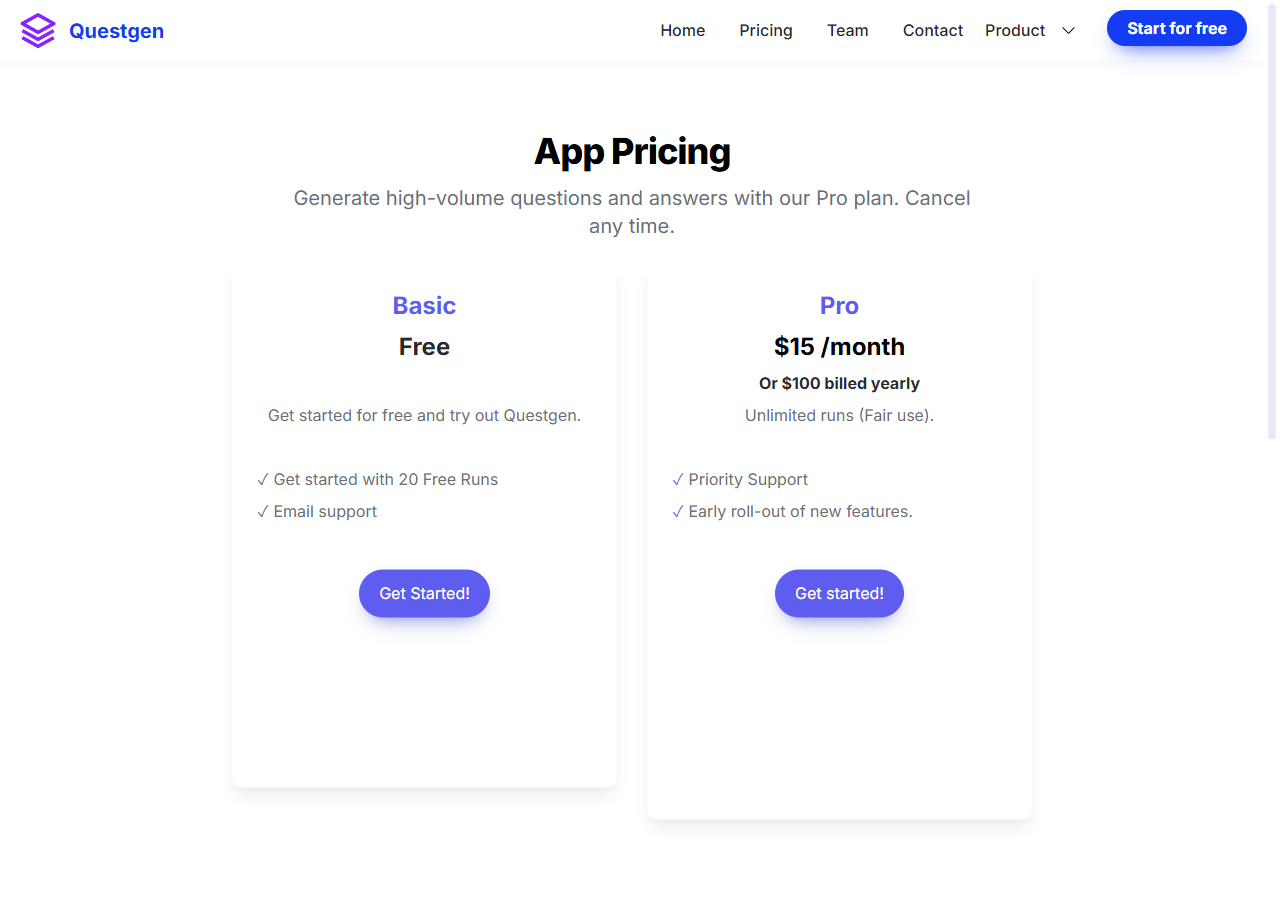
↔ Swipe sideways on a narrow screen
The price. Free covers 20 runs; Pro is $15/month, or $100 billed yearly. ⚠️ Our 2026-08-14 note said pricing sat behind signup and could not be checked. That was wrong — there is a public pricing page. Corrected 2026-08-16, and we are leaving the correction visible rather than quietly editing it out.
Captured 2026-08-16 · it may have changed since
Step 3. How customers arrive questgen.aiOpen the real page ↗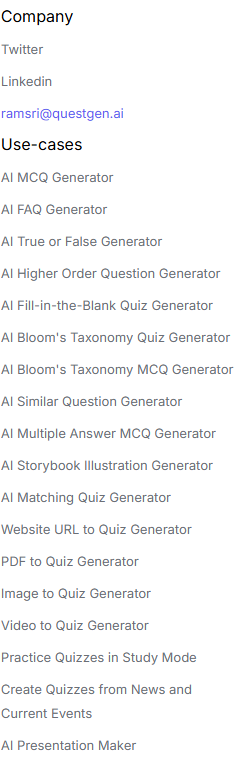
How customers arrive. One footer column lists 18 separate use-case pages — “PDF to Quiz,” “Video to Quiz,” and so on. Instead of one homepage trying to catch everyone, there is a door per search term. The channel is pages, not ad spend.
Captured 2026-08-16 · it may have changed since
Step 4. Who runs it questgen.aiOpen the real page ↗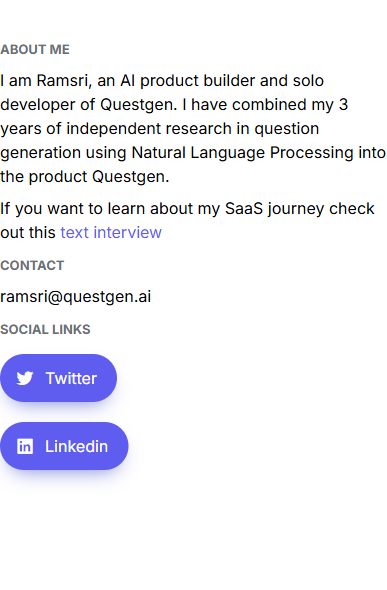
Who runs it. The founder calls himself the solo developer on the official site. That is his own statement, not independent confirmation. The same paragraph mentions three years of research into question generation — which is exactly why this one is hard to copy. It reads less like AI creating a business and more like a researcher shipping a product with AI.
Captured 2026-08-16 · it may have changed since
These screenshots are quoted for analysis; the underlying pages belong to their owners. We left out faces and the sellers' education and career panels — what we are reading is the price and the order record, not the person.
- Founder
- Ramsri Goutham Golla
- Country
- IN
- Team
- —
- Startup cost
- —
- To first revenue
- —
- Automation
- high
- Reported revenue
- Revenue not disclosed
What is sold
SaaS subscription, free to start
Free for 20 runs, then $15/month (or $100 billed yearly), read off the public pricing page on 2026-08-16. You use it without a card first; the subscription starts where the free allowance ends. ⚠️ Our 2026-08-14 note said pricing sat behind signup and could not be checked. That was wrong — we had looked only at the homepage and missed the public pricing page.
Who buys
Teachers and schools, HR teams, publishers and edtech
What arrives is not what you keep
- What the customer paidThe number on the invoice
- AI toolsA share of the monthly subscription
- Platform feeDiffers by platform
- TaxDiffers by country and business form
- What is leftAt or below zero, it is not a price
This case does not publish its own tool costs, fees or tax. So we show the order and the items only — put your own numbers into the calculator.
AI's part and the person's part
Already had
Data scientist. This is the most important field in this case — natural-language expertise maps directly onto the product's core feature.
If this is large, the AI is not the reason
What the AI did
Feed it a document, image, video, or web page and it produces multiple-choice, true/false, and fill-in-the-blank questions. Generating the questions is the product, and it replaces work a person used to do by hand.
the part a tool replaced
What the person did
The founder builds and runs it. As checked on 2026-08-14 the site shows no careers page, no team page, and no investors, and the footer links the founder's own email address. The same founder also runs another AI app (AiArtist).
stories that omit this do not replicate
How customers were found
Product-led — free trial, no card required
18 use-case landing pages — counted in the footer ourselves (2026-08-16)
The founder's public presence
Paying customers
Free for 20 runs
Flow: Product-led — free trial, no card required, then 18 use-case landing pages — counted in the footer ourselves (2026-08-16), then The founder's public presence, then Paying customers
How we verified this
Public dashboard or platform figure. May be self-reported
We confirmed on 2026-08-14 that the product resolves and checked its operating scale directly: no careers, team, or investor pages, and a founder email in the footer. The founder is named. But the only source for revenue is the founder, with no payment-processor link or third-party confirmation, so this is a B. The site's “150,000+ users” and “2.5M+ questions” are self-reported; we did not verify them and do not rely on them. Re-checked 2026-08-16. We found the public pricing page and captured it (20 free runs; Pro at $15/month or $100/year). Our 8/14 note that pricing could not be checked was our own research gap, and it is corrected. The team page has the founder calling himself the solo developer — his own statement, so we do not treat it as independent confirmation of a one-person operation. In that page's footer we counted 18 use-case landing pages; that is a number anyone can count off the screen, so we do use it. The grade stays B. What changed is *what it charges*. What it earns is still unconfirmed.
- QuestGen official site — product live, operating scale checked (official_site · checked 2026-08-14)
- Public pricing page — 20 free runs, Pro at $15/month or $100/year (official_site · checked 2026-08-16)
- Team page — the founder describes himself as the solo developer; the same page's footer lists 18 use-case landing pages (official_site · checked 2026-08-16)
What made it work
What the AI removed was the labour of writing questions — and the market chosen was one where that labour was already expensive (teaching and assessment). The decisive choice looks less like picking a good tool and more like picking a place where the disappearing labour was costly.
Risks
- The main risk is replicability. The founder is a data scientist and that expertise overlaps the product's core feature. Separate “because of AI” from “already knew this field” and this case leans heavily on the second. A non-specialist should not expect the same result. General-purpose models also keep absorbing this feature, which is continuous substitution pressure.
Does this work in Korea?
The structure transfers: nothing about it is US- or India-specific. Selling subscriptions to individuals abroad does require sorting out payment and sales tax (which differs depending on whether you use a Merchant of Record). Selling to Korean schools and public institutions adds a separate procurement process.
Solo-feasible: yes · Automation: high
7-day action plan
Step 1. Write down a field you already know
this case started with domain knowledge, not with a tool
Step 2. In that field, pick one artefact people produce repeatedly by hand
Step 3. Make one of them with AI and record how long it took
30-day action plan
Step 1. Show it to five people who actually use that artefact and record their reaction
do not sell
Step 2. Publish it in a form people can use for free and watch whether they do
Step 3. Attach a price only once people are using it. If nobody does, change the artefact, not the price
Run the numbers
We do not print a single projected figure here. Put your own numbers in instead.
How this reads for you
Answer 13 questions and we work out what this case would take in your situation. Answers stay in this browser.
Find models that fit youGet the next verification result
We check the AI income stories people are talking about, grade the evidence, and send you what we found — including what we could not confirm.
Income models this case supports
- Level 4Micro SaaS
Related cases
Words you may not know
- Verification grade
- How far we checked this case. A means the revenue was confirmed by someone other than the founder; B means the business exists but the revenue is only the founder's word.
- Revenue
- Everything that came in. Tools, fees and tax still have to come out before it is what you keep. The two are not the same.
- MRR
- Money that arrives every month, as opposed to a one-time payment.
- Self-reported
- A number the person stated about themselves. Nobody else confirmed it, which is why we do not print those numbers.
- Replicability
- How likely someone else is to get a similar result. The more the founder already knew the field, the harder it is to copy.